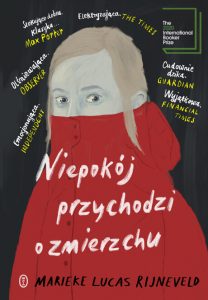
The Discomfort of Evening is a book written by 30 year old Dutch author Marieke Lucas Rijneveld, which was translated into English from its original title “De avond is ongemak.” The book was inspired by the death of Marieke’s brother while she was three years old.
Life consists of details. Little snippets, moments and approximations. But what is it that makes the individual components form a common and coherent whole? What makes these details stay in a constant position in relation to each other? Is there some gravitational center around which they orbit? Or more prosaically, have they been glued together by a magical glue? What gives them their fixed structure?
Let us assume that there is some undefined force that keeps the details of life in motion and in mutual relation. Which gives them a common direction and a common identity. The very structure. In order for such a life, understood as a collection of details, to work, do specific conditions have to be met? Does it have to contain all the given and acquired elements permanently?
And what if one element is suddenly missing?
For example, the smelly cow cream rubbed on the face by a caring mother? The yellow layer of cream sticking to your palate? The unruly curl on your forehead?
Will there be a gaping hole left behind forever? Will this gap, this void, be filled with something new with time? Single details will gently and slowly, yet relentlessly, begin to change their own trajectory, thus returning to the previous balance of power? Will they fill the void, regaining the status quo from before the loss? Or will they at least mask it? Will it be impossible to salvage such a depleted here and now, and must all remaining details and conditions be converted as quickly as possible, while the continuity of this structure still exists?
Or maybe the balance will be disturbed permanently and details will scatter disorderly, deprived of their concentrating force?
Marieke Lucas Rijneveld reflects on the dynamics of these phenomena in her delightful book “The Discomfort of Evening“. The young Dutchwoman, rightly awarded the Booker prize, looks at the mechanism of life and the consequences that arise when the balance of power is disturbed.
The coziness of rural life is the backdrop for a story of family trauma. Interactions, expectations, and fears, told from the perspective of the ten-year-old narrator, pulsate with the weight of guilt. The prose, dense with detail, is overwhelming in its realism. The world is as real as it is brutal.
True, which is brutal.
The death of the oldest child in the family sets off a chain reaction of disintegration. Individual family members, who previously constituted a whole, close themselves in their own pain. They wrap themselves in grief and remorse like a warm pudding. It seems that if there is any common denominator for this family now, it is loneliness. It has encroached between the household and has led to a disintegration of relationships and emotions. Parents do not take care of children, children devise probable and improbable types of their parents’ deaths. For practice, so as not to be surprised a second time. The only manifestations of children’s feelings are new tics.
“Father and mother don’t see our tics. They haven’t figured out that the fewer the rules, the more we make them up ourselves. “*
That is, rules. Rules are able to maintain the planetary movement of life. To maintain balance in the torn structure of detail. Rules can restore rhythm, pulse. Step by step lead out of trauma. Fill the hollow in the mattress of the dead. Give back meaning. Restore logic. Even if the rule is to become mortification, torment and mutilation. According to Newton’s dynamics, centrifugal force and centripetal force balance each other. Common direction, different vectors. So the thesis should be replaced by the antithesis. Caring is masochism. Childish innocence – sexual arousal. Truth – fiction. Life – death.
Or maybe this already violated structure of life, intertwined with childish imaginings and experiences, is not subject to the laws of physics? And it cannot be fixed by simple logic. Maybe the ancients were right? This logic will betray us. And so will astronomy.
A cruel God demands sacrifices. Weeping is replaced by madness.
You can turn out the light.
———
*M.L. Rijneveld, “Niepokój przychodzi o zmierzchu” (“Anxiety Comes at Dusk”), published by LIterackie, Krakow 2021, p. 84
Więcej rekomendowanych książek znajdziecie tutaj.
[:pl]Niepokój przychodzi o zmierzchu to książka napisana przez 30-letnią holenderską autorkę Marieke Lucas Rijneveld, która została przetłumaczona na język polski z jej oryginalnego tytułu “De avond is ongemak.” Książka została zainspirowana śmiercią brata Marieke, gdy miała trzy latka.
Życie składa się z detali. Małych skrawków, momentów i przybliżeń. Ale co sprawia, że pojedyncze składniki tworzą wspólną i spójną całość? Co sprawia, że te detale utrzymują się w stałym położeniu względem siebie? Istnieje jakieś centrum grawitacyjne, wokół którego orbitują? Czy może bardziej prozaicznie, zostały sklejone ze sobą nawzajem magicznym spoiwem? Co nadaje im stałą strukturę?
Załóżmy, że istnieje jakaś bliżej nieokreślona siła, która utrzymuje detale życia w ruchu i wzajemnej relacji. Która nadaje im wspólny kierunek i wspólną tożsamość. Strukturę właśnie. Czy, żeby takie życie, rozumiane jako zbiór detali, zadziałało, muszą zostać spełnione konkretne warunki? Czy muszą zostać zawarte w nim na stałe wszystkie dane i nabyte elementy?
A co, gdy jednego elementu nagle zabraknie?
Na przykład śmierdzącego kremu krowiego wcieranego w twarz przez troskliwą mamę? Żółtej warstwy śmietany przyklejającej się do podniebienia? Niesfornego loczka na czole?
Czy pozostanie po nich na zawsze wyrwa? Czy z czasem taka wyrwa, pustka, zapełni się czymś nowym? Pojedyncze detale delikatnie i wolno, acz nieustępliwie, zaczną zmieniać własną trajektorię, powracając tym samym to poprzedniego układu sił? Zapełnią pustkę, odzyskując status quo sprzed utraty? Albo chociaż zamaskują? Czy może jednak nie da się uratować takiego uszczerbionego tu i teraz i należy jak najszybciej przekonwertować wszystkie pozostałe detale i warunki, póki jeszcze ciągłość owej struktury trwa?
A może równowaga zostanie zaburzona już na stałe i detale rozsypią się bezładnie, pozbawione skupiającej je siły?
Nad dynamiką tych zjawisk zastanawia się Marieke Lucas Rijneveld w swojej zachwycającej książce ” Niepokój przychodzi o zmierzchu”. Młoda holenderka, słusznie nagrodzona nagrodą Bookera, przygląda się mechanizmowi życia i konsekwencjom, wynikającym z zaburzenia układu sił.
Przaśność wiejskiego życia jest tu tłem dla historii rodzinnej traumy. Wzajemne relacje, oczekiwania, lęki, opowiedziane z perspektywy dziesięcioletniej narratorki pulsują od ciężaru poczucia winy. Gęsta od detali proza przytłacza swoim realizmem. Świat tyleż prawdziwy, co brutalny.
Prawdziwy, co brutalny.
Śmierć najstarszego dziecka w rodzinie zapoczątkowała reakcję łańcuchową rozpadu. Poszczególni członkowie rodziny, którzy wcześniej stanowili całość, zamykają się we własnym bólu. Otulają się żalem i wyrzutami sumienia, jak ciepłą budrysówką. Zdaje się, że jeżeli jest obecnie jakiś wspólny mianownik dla tej rodziny, to jest nim samotność. Wdarła się między domowników i doprowadziła do dezintegracji relacji i emocji. Rodzice nie zajmują się dziećmi, dzieci obmyślają prawdopodobne i nieprawdopodobne rodzaje śmierci rodziców. Dla wprawy, żeby drugi raz nie dać się zaskoczyć. Jedynymi przejawami uczuć dzieci są nowe tiki.
“Ojciec i matka nie widzą naszych tików. Nie zorientowali się, że im mniej reguł, tym więcej sami ich wymyślamy.”*
Czyli reguły. Reguły są w stanie utrzymać planetarny ruch życia. Zachować równowagę w rozerwanej strukturze detali. Reguły mogą przywrócić rytm, puls. Krok za krokiem wyprowadzić z traumy. Zapełnić zagłębienie w materacu zmarłego. Oddać sens. Przywrócić logikę. Nawet jeśli regułą ma się stać umartwianie, zadręczanie i okaleczanie. Zgodnie z dynamiką Newtona siła odśrodkowa i dośrodkowa równoważą się. Wspólny kierunek, różne wektory. Zatem tezę należy zastąpić antytezą. Troskę – masochizmem. Dziecięcą niewinność – pobudzeniem seksualnym. Prawdę – fikcją. Życie – śmiercią.
A może taka naruszona już struktura życia przeplatana dziecięcymi imaginacjami i doświadczeniami nie podlega prawom fizyki? I nie da się jej naprawić prostą logiką. Może starożytni mieli do rację? Zdradzi nas ta logika. Astronomia zresztą też.
Okrutny Bóg żąda ofiar. Płacz zostaje zastąpiony szaleństwem.
Można zgasić światło.
—-
*M.L. Rijneveld, “Niepokój przychodzi o zmierzchu”, wyd. LIterackie, Kraków 2021, str. 84
Więcej rekomendowanych książek znajdziecie tutaj.
[:]